
Operationalizing Agentic AI: Building Bulletproof Virtual Staff for Small Business
For a small business, time isn’t just money—it’s survival. Between managing operations, handling inventory, and delivering services, customer communication frequently becomes a time intensive bottleneck. Missing a single phone call or letting a website chat message sit unanswered can mean losing a customer to a faster competitor.
Enter Agentic AI. Unlike traditional chatbots that rely on rigid decision trees, agentic AI uses advanced reasoning to understand intent, resolve complex issues, and execute multi-step workflows. Implementing a web-based chat agent and a voice-activated phone assistant can effectively give a business a 24/7 front desk.
However, deploying these tools without proper constraints can lead to “hallucinations,” data leaks, or awkward brand interactions. To ensure an AI system remains an asset rather than a liability, business owners must build the agent to live within a very specific area of information.
1. The Dynamic Duo: Web Chat and Voice Agents
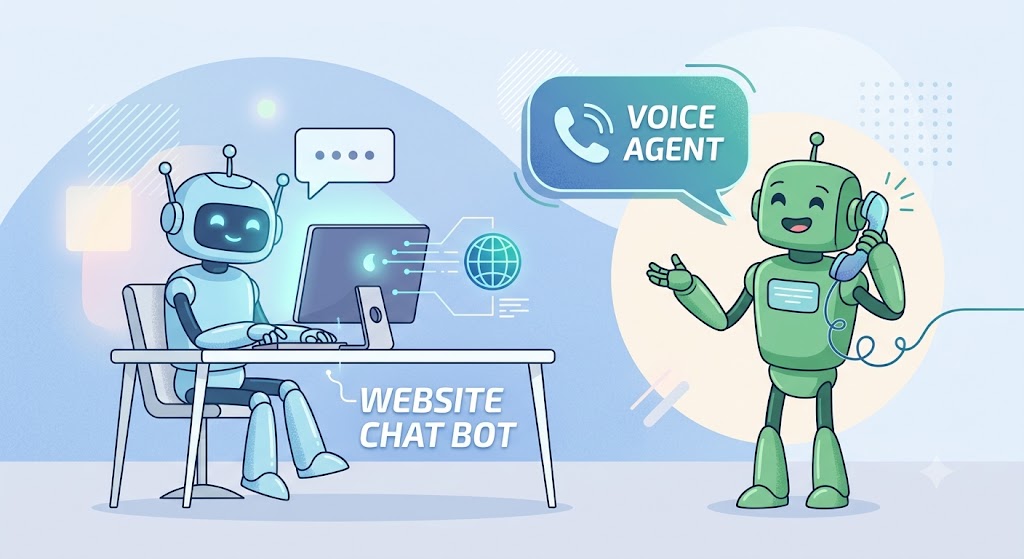
Deploying agentic AI across both text and voice channels ensures seamless coverage where small businesses need it most.
The Website Chat Agent
A website chat bot serves as the digital front door. Instead of just pointing users to an FAQ page, an agentic chatbot can look up specific product data, check reservation availability, or walk a user through common troubleshooting steps. It handles the high-volume, low-complexity inquiries that typically eat up hours of the day.
The Voice Agent
A voice agent takes over phone operations, interacting naturally with callers in real-time. It eliminates the clunky, frustrating experience of traditional “Press 1 for Sales” menus. A properly tuned voice agent can answer complex questions about services, capture leads, or book appointments directly into a calendar, ensuring that no lead falls through the cracks—even after hours.
2. Guardrails: Guarding Against Intentional Derailment
The biggest risk of deploying a public-facing Large Language Model (LLM) like Claude, Gemini or ChatGPT is its inherent flexibility. Without strict boundaries, a curious user can easily trick an AI into writing poetry, talking about competitors, or worse, generating offensive content running your bill through the roof.
[User Input] ──► [System Prompt / Guardrails] ──► [Curated Knowledge Base] ──► [Safe Response]
                       │
                       └───► (Blocks non-business or adversarial queries)
To prevent an AI from getting “lost” with random, non-business questions, developers and business owners use a multi-layered security strategy:
-
Rigid System Prompts: The foundational instructions must clearly define the AI’s identity. For example: “You are an AI assistant for The Bourquin Group. You only answer questions related to our services, hours, pricing, and policies. If a user asks a question outside of these topics, politely decline to answer and steer the conversation back to the business.”
-
Retrieval-Augmented Generation (RAG): Instead of letting the AI pull answers from its broad training data, RAG forces the system to look only at a curated business database (like a company wiki, product catalog, or handbook) before responding. If the answer isn’t in the provided documents, the AI is instructed to say it doesn’t know.
-
Input/Output Filtering: Software guardrails (such as Llama Guard or custom regex filters) sit between the user and the AI. If a user tries to ask about a political event or requests code generation, the filter flags the input and triggers a boilerplate rejection before the AI even processes it.
3. Designing a Seamless Human Handoff
An AI agent should never be the only contact available to your customers. If a customer has a specific grievance that is outside of its ability to assist, an emotional complaint, or a high-value transaction requirement, the AI needs to be able to handoff the customer to a human team member.
A solid handoff strategy relies on two core mechanisms and some review:
-
Sentiment & Complexity Triggers: The AI should automatically flag conversations where a customer displays frustration, uses aggressive language, or asks a question that fails to match the internal knowledge base after two attempts.
-
Omnichannel Notifications: When a handoff is triggered, the system should instantly alert the owner or staff via SMS, email, or internal chat apps (like Slack or Teams), providing a full transcript of the conversation so the human can step in with total context.
- Transcript Review: This is a hypercritical step many business owners fail to do. Someone needs to review at least a random selection of transcripts and adjust the data so that it fits better with the value offered by the business and the needs of the customer. Just as your employees need to continuously learn, so does your AI
| AI Channel | Primary Function | Key Guardrail Strategy |
| Website Chat | Lead capture, FAQ triage, order tracking | Strict RAG database parsing to prevent off-topic chat. |
| Voice Agent | Appointment booking, phone answering |
Strict RAG database parsing to prevent off-topic chat. |
This article was written with the assistance of Google Gemini Flash 3.5 and verified by Scott Bourquin
Are You Ready To AI Enhance Your Business?
AI isn’t a human replacement but rather an enhancement to human performance. Are you ready to see how AI can enhance your business?
